Reading time: 6 minutes | Updated for the 2026 Dubai summer season
Dubai summers push outdoor temperatures past 45°C, and every one of those degrees works against your cold room. Condenser units overheat, door seals fail faster, and compressors run longer just to hold the same internal temperature. For restaurants, supermarkets, and warehouses across the UAE, a poorly maintained cold room in summer is the fastest way to lose stock, fail a food-safety inspection, or face an emergency shutdown during peak trading hours.
This guide covers exactly how to maintain a cold room in summer — the checks, the schedule, and the warning signs — based on what our refrigeration engineers see on service calls across Dubai, Abu Dhabi, Sharjah, Ajman, Fujairah, Ras Al Khaimah, and Umm Al Quwain every year.
Why Summer Is the Hardest Season for a Cold Room
A cold room doesn’t just fight the temperature inside the box — it fights the temperature outside it. As ambient heat rises, the condenser has to reject more heat into already-hot air, so the compressor works harder and runs longer cycles. In Dubai’s climate, that means:
- Higher compressor load — units run 30–40% longer than in winter to hold the same setpoint
- Faster refrigerant pressure build-up, especially on rooftop or outdoor condensing units exposed to direct sun
- Door seal degradation from heat and constant opening in busy kitchens
- Dust and sand accumulation on condenser coils, which is worse near industrial areas like Al Quoz and Jebel Ali
Left unchecked, these stresses lead to the two most common summer cold room failures we’re called out for: compressor burnout and stock loss from slow temperature creep that goes unnoticed until it’s too late.
Cold Room Summer Maintenance Checklist
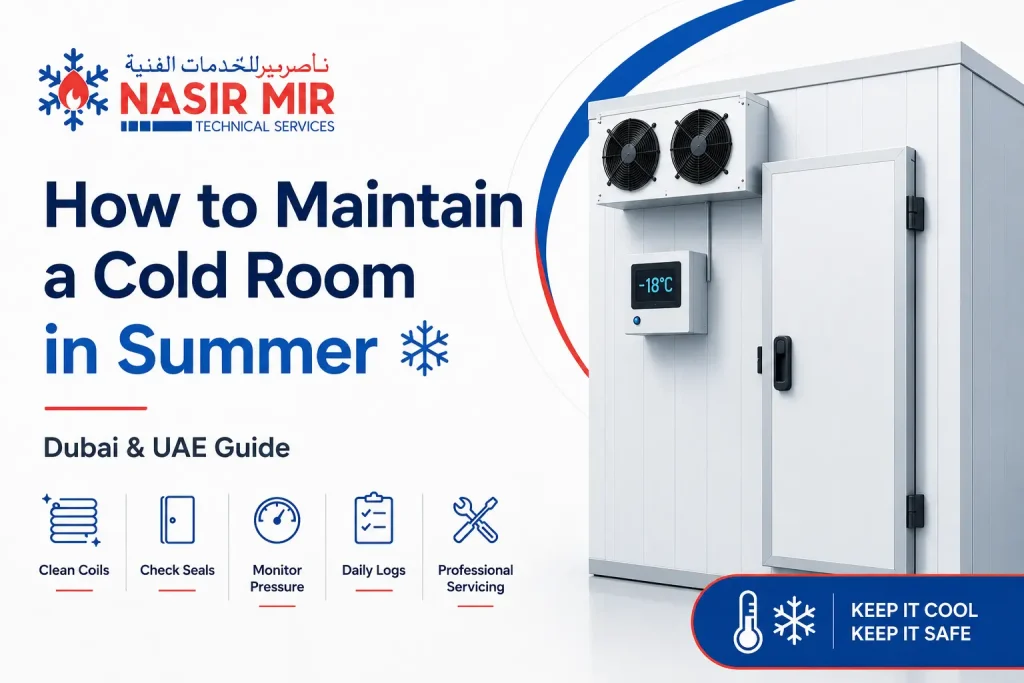
1. Clean the Condenser Coils Monthly, Not Quarterly
In summer, dust and grease on condenser coils act as insulation — the exact opposite of what you need. A coil that’s 30% blocked can raise head pressure enough to trip the compressor on a hot afternoon. During peak summer months (May–September), coils should be inspected and cleaned monthly rather than the usual quarterly schedule.
2. Check Door Seals and Gaskets Weekly
Heat makes rubber gaskets brittle faster. A gap as small as 2mm around a door seal lets warm, humid air flood the room every time it’s opened, forcing the compressor to work overtime to recover. Run a simple paper test — close the door on a sheet of paper and try to pull it out. If it slides out easily, the seal needs replacing.
3. Monitor Refrigerant Pressure and Levels
Low refrigerant charge is far more dangerous in summer than winter, because the system has less thermal margin to begin with. A technician should verify suction and discharge pressures against manufacturer specs at least once before peak season and again mid-summer.
4. Keep Condensing Units Shaded and Ventilated
Outdoor or rooftop condensing units exposed to direct sun in Dubai can see ambient temperatures at the unit itself exceed 55–60°C. Where possible, install shading structures or louvered screens — never plastic sheeting, which traps heat — and make sure there’s at least 60cm of clearance on all sides for airflow.
5. Track Internal Temperature Logs Daily
A slow temperature creep of even 2–3°C over several days is easy to miss without logging. Daily temperature checks (digital loggers or manual logbooks) catch a failing compressor or blocked evaporator before stock is compromised, and give you a paper trail for food-safety audits.
6. Schedule Professional Servicing Before Peak Heat
A full Annual Maintenance Contract (AMC) visit before the summer season begins — ideally in March or April — should include compressor amperage testing, evaporator fan checks, drain line clearing, and a full refrigerant leak test. This is the single most effective step to prevent a mid-July breakdown.
Warning Signs Your Cold Room Needs Emergency Attention
- Compressor cycling on and off more frequently than usual
- Ice buildup on the evaporator coil (often a sign of low refrigerant or airflow blockage)
- Condensation or water pooling around the door frame
- Unusual noise from the compressor or fan motors
- Internal temperature drifting more than 2°C from setpoint
If you notice any of these, don’t wait for the next scheduled visit — in Dubai’s summer heat, a small fault can escalate to full stock loss within hours. NMT Services offers 24/7 emergency support for exactly this reason.
Cold Room Maintenance Across the UAE
Summer stresses on refrigeration systems aren’t unique to Dubai. Our technicians service cold rooms in Abu Dhabi, Sharjah, Ajman, Fujairah, Ras Al Khaimah, and Umm Al Quwain throughout peak season, and the same coastal humidity and high ambient heat apply across the Emirates — coastal cities like Sharjah and Fujairah add extra humidity load on top of the heat, which accelerates gasket wear even faster than in drier inland areas.
How NMT Services Helps
NMT Services designs, installs, and maintains cold room systems in Dubai for restaurants, supermarkets, hotels, and industrial facilities. Our summer maintenance visits cover every item on the checklist above, backed by licensed technicians and 24/7 emergency support when something can’t wait.
If your cold room shares plant space or ductwork with your building’s climate-control system, it’s also worth having our HVAC services team inspect both together — a struggling HVAC system in a hot plant room raises ambient temperatures around the cold room condenser and compounds the problem. For commercial kitchens running cold storage alongside cooking lines, our kitchen installation and maintenance team can service both systems in a single visit to minimize downtime.
Frequently Asked Questions
How often should a cold room be serviced in summer?
During peak summer months (May–September), condenser coils should be cleaned monthly and door seals checked weekly, with at least one full professional service visit before the season begins and another mid-summer.
What temperature should a commercial cold room hold in summer?
Most commercial cold rooms hold 0–4°C for chilled storage and -18°C or below for freezer storage, regardless of season. The challenge in summer is maintaining that setpoint consistently as ambient heat rises, not changing the target temperature itself.
Why does my cold room struggle more in Dubai summers specifically?
Ambient temperatures above 45°C force the condenser to reject heat into already-hot air, increasing compressor run time by 30–40% compared to winter. Outdoor units exposed to direct sun can see local temperatures at the unit itself exceed 55–60°C.
Can I prevent a cold room breakdown during summer?
Most summer breakdowns are preventable with a pre-season AMC visit, monthly coil cleaning, and weekly seal checks. Catching a slow refrigerant leak or a blocked coil in April is far cheaper than an emergency callout in July.
For guidance on safe cold storage temperature ranges for perishable food, the FDA’s safe food storage temperature guidelines are a useful reference point alongside your local UAE food-safety requirements.
Need your cold room checked before peak summer hits? Contact NMT Services for a pre-season inspection or emergency support anywhere in Dubai, Abu Dhabi, Sharjah, Ajman, Fujairah, RAK, or Umm Al Quwain.