Cold Room Temperature Rising? A Fault-Finding Guide for UAE Businesses
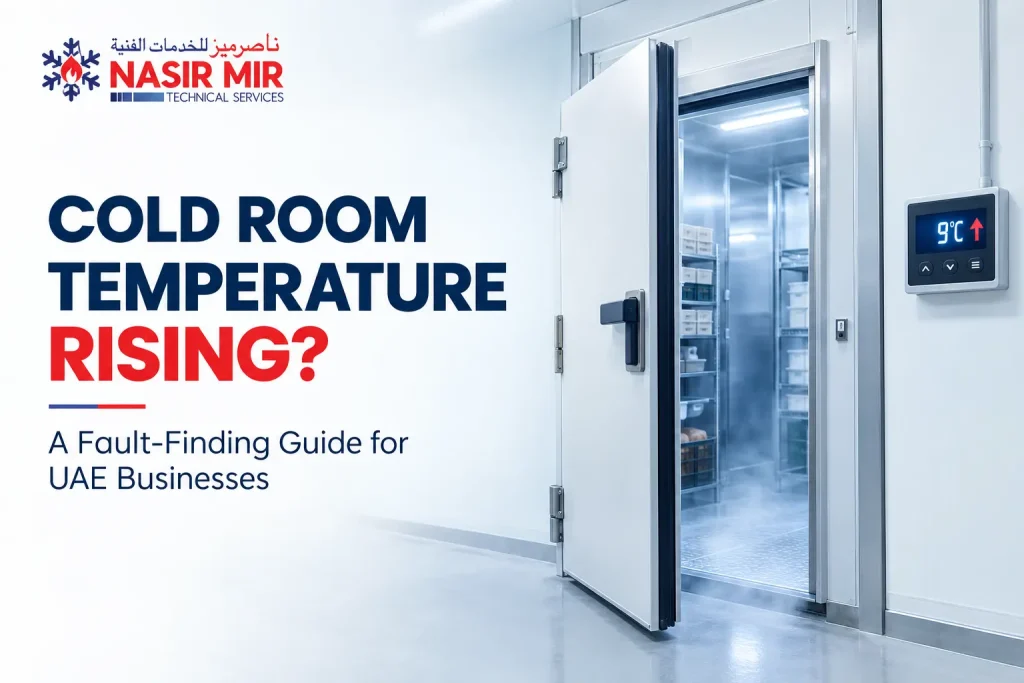
It’s 11:40 on a Thursday morning. You open the walk-in to start lunch prep and the display reads 9°C. Yesterday it said 3°C. Nobody touched the thermostat, the compressor is humming, and your chef is already asking if the chicken is okay.
That moment, when you know something is wrong but not what, is where most of the damage happens. People either panic and call out an engineer for a fault they could have spotted in two minutes, or they wait and hope while the cold room temperature keeps rising.
This guide is about the middle ground. We’ll walk through what to check in the first 10 minutes, how to protect your stock, how to read the clues your cold room is giving you, and what to tell the technician so the fix is faster. It’s written for restaurant owners, kitchen managers, supermarket and warehouse teams across the UAE, not for refrigeration engineers.
Quick Fault-Finder: What to Do, Check and Say
Short on time? Tap a tab for the fast version. The full explanation for each step follows below.
Confirm the Reading
Put a second thermometer inside. If it disagrees with the display, you may have a sensor fault, not a cooling fault.
Keep the Door Shut
Every check lets warm, humid air in. Take what you need in one trip and latch the door properly.
Listen, Look, Check the Breaker
Are the compressor and fans running? If the breaker tripped, reset it once only. If it trips again, stop.
Note the Time, Protect the Stock
Write down when it started and measure the food core temperature. Move high-risk items to working refrigeration.
Sensor or Settings
Probes drift and settings get changed. Compare the controller with a second thermometer and ask who last touched it.
Door, Load and Airflow
Warm deliveries, a door left ajar or boxes blocking the evaporator fans can push the temperature up fast.
Condenser and Heat
Dusty fins, a dead fan or a hot, enclosed plant space stop the system dumping heat. Afternoon-only warming is the giveaway.
Refrigerant and Electrical
Constant running with no ice, a silent compressor or repeated tripping all need a trained, certified technician.
Call or WhatsApp Us
Reach our 24/7 team and tell us what the cold room is doing right now.
Describe the Pattern
When it started, whether it is constant or only in the afternoon, and what the compressor and fans are doing.
Send Photos or a Short Video
A shot of the display, the evaporator and the outdoor unit helps us bring the right parts.
Leave the Risky Jobs to Us
Refrigerant, wiring, forced defrosts and hosing a live condenser are never DIY jobs.
What Should You Do in the First 10 Minutes When Your Cold Room Temperature Starts Rising?
Don’t touch anything technical yet. Just work through these in order:
- Check the reading with a second thermometer. Put a separate thermometer (or a probe in a glass of water) inside the room. If the display says 9°C and your thermometer says 3°C, you have a sensor or display fault, not a cooling fault.
- Stop opening the door. Every time someone checks, warm, humid air rushes in. Ask staff to take what they need in one trip.
- Listen and look at the compressor and fans. Is the outdoor unit running? Are the fans inside the room spinning? Silence usually points to power or controls. Running non-stop points somewhere else (more on that below).
- Check the breaker once. If it has tripped, reset it one time. If it trips again, stop. Repeated resetting can damage the compressor and is a safety risk.
- Write down the time. You’ll need it to judge how long your stock has been warm, and your technician will ask.
- Measure the food, not just the air. Air temperature jumps around when a door opens. The core temperature of the product is what matters for safety.
How Long Can Food Stay in a Warm Cold Room Before It’s Unsafe?
This is the question that keeps managers up at night, so let’s be clear about the rules you’re measured against.
In Dubai, the Dubai Municipality Food Code sets the framework food businesses are inspected under, and the working targets most UAE kitchens follow are 5°C or below for chilled food and -18°C or below for frozen food. Once your chilled stock is above 5°C, the clock is running.
For how fast that clock moves, the US food safety authority gives a widely used reference. The USDA says bacteria in the “danger zone” (between roughly 4°C and 60°C) can double in number in as little as 20 minutes, and that perishable food shouldn’t sit there for more than two hours, or just one hour when the surrounding temperature is above about 32°C. In a UAE summer, a warm kitchen can easily be above that. So don’t assume you have two hours.
A practical rule: if high-risk stock (raw meat, seafood, dairy, cooked food) has been above 5°C for a while and you can’t say exactly how long, move it to working refrigeration or follow your own HACCP plan and your inspector’s guidance. We’re refrigeration engineers, not food-safety regulators, so when it’s a discard-or-keep decision, your food safety procedures have the final word.
Why Is Your Cold Room Temperature Rising? Read the Clue First
A cold room rarely just “breaks.” It usually leaves a pattern. Match what you’re seeing to the table below and you’ll know which cause to look at first.
| What you notice | Most likely cause |
|---|---|
| Display is high, but the food feels cold | Faulty sensor or wrong settings |
| Gets warm only in the afternoon, recovers at night | Condenser can’t shed heat (dirty coil, failed fan, hot plant space) |
| Rises after deliveries or a busy service, then recovers slowly | Door traffic, overloading or warm stock going in |
| Compressor running non-stop, ice on the coil or fans | Defrost failure or blocked airflow |
| Compressor running non-stop, no ice, never quite reaches setpoint | Low refrigerant (a leak) or a struggling compressor |
| Compressor silent, temperature climbing steadily | Power, electrical or compressor failure |
| Clicks on and off every few minutes | Short cycling (pressure, controls or electrical issue) |
1. A Sensor or Setting Problem (Check This First)
It’s the cheapest fault to rule out. Temperature probes drift over time, and settings get changed by someone “just adjusting it a little.” Compare the display with your second thermometer, and ask who last touched the controller. If the room is genuinely cold and only the display is wrong, you’ve saved yourself a callout and your stock is fine.
2. Door Traffic, Overloading or Warm Stock
A big delivery of room-temperature stock, hot food put in to cool, or a door that’s propped open during a rush can push the temperature up faster than the system can pull it down. If the room recovers once things calm down, the equipment may be perfectly healthy. Check that the door latches properly and closes fully, and keep strip curtains in good shape. If the seal itself is the suspect, our commercial cold room maintenance guide shows the simple paper-or-note test.
3. Blocked Airflow or a Frozen Evaporator
The evaporator is the part inside the room that actually absorbs the heat. If boxes are stacked against its fans, or ice has built up on the coil because defrosting has stopped working, cold air can’t circulate. The thermostat then thinks the room is warm and the compressor runs and runs. Never chip ice off with a knife or screwdriver. It’s easy to puncture a coil, and that turns a defrost problem into a refrigerant leak.
4. A Condenser That Can’t Get Rid of Heat
This is the classic UAE fault, and the afternoon clue gives it away. Dust-clogged fins, a dead condenser fan, or an enclosed plant space that traps hot air all mean the system can’t dump heat outside. The room copes at night, then loses the fight at 3 PM. If your problem is seasonal, our summer cold room maintenance guide covers how to prepare for it. If it’s happening right now, don’t hose down a running unit. Switch it off at the isolator and call for service.
5. Low Refrigerant
Refrigerant isn’t “used up” like fuel. If the level is low, there’s a leak somewhere. Signs include a system that runs constantly without reaching setpoint, partial frosting, or oily residue around joints. Topping up the gas without finding the leak only buys you a few weeks. This is a job for a trained, certified technician.
6. Compressor or Electrical Faults
A silent compressor, a loud hum without starting, repeated tripping, or a unit that clicks on and off every few minutes can all point to a failing capacitor, contactor, overload, a voltage problem or the compressor itself. Don’t open electrical panels. This is where waiting makes things worse, because a stressed compressor can burn out.
What Can You Safely Do Yourself, and What Should You Leave Alone?
Safe for your team
- Checking the temperature with a second thermometer
- Closing and latching the door, and limiting how often it opens
- Clearing stock away from the evaporator fans
- Resetting a tripped breaker once
- Moving high-risk stock to working refrigeration
- Keeping a written log of temperatures and times
Leave to a technician
- Anything involving refrigerant gas
- Electrical panels, wiring, contactors or capacitors
- Chipping ice or forcing a defrost
- Bypassing safety switches or thermostats to “keep it running”
- Washing a live condenser with water
What Should You Tell the Technician to Get a Faster Fix?
The more specific you are on the phone, the more likely the engineer arrives with the right parts. Have these ready:
- When it started and whether it’s getting worse
- The pattern: constant, only afternoons, only after deliveries
- What the compressor and fans are doing: running, silent, clicking
- Whether there’s ice on the coil, fans or ceiling
- Any recent changes: new stock volume, settings changed, a power cut, a recent service
- A photo or short video of the display, the evaporator and the outdoor unit
How Do You Stop It From Happening Again?
Once the cold room is cold again, take ten minutes to find out why it happened. If the cause was wear that should have been caught earlier, read our guide on the signs your cold room needs repair, not just maintenance. If you want a regular schedule so nobody has to guess, look at how a planned annual maintenance contract works for commercial kitchens. Cold storage that shares plant space with building cooling can also run hotter than it should, which is where our HVAC services team can inspect both together.
Need Help Finding the Fault?
NMT Services installs, repairs and maintains cold rooms for restaurants, hotels, supermarkets and warehouses. Our cold room installation, repair and maintenance team in Dubai also covers Abu Dhabi, Sharjah and Ajman, with 24/7 emergency support.
Temperature climbing right now? Message us on WhatsApp at +971 50 709 4400 with a photo of the display, or contact our team and tell us what you’re seeing.
Frequently Asked Questions
Why is my cold room temperature rising even though the compressor is running?
A running compressor doesn’t guarantee cooling. If the evaporator is iced up, the condenser is clogged or the refrigerant is low, the compressor can run all day and still not hold temperature. Check for ice and airflow first, then call a technician.
Is it normal for the temperature to rise slightly during defrost?
Yes. A small, short rise during a scheduled defrost cycle is normal, and it should come back down on its own. If the temperature keeps climbing between defrosts or doesn’t recover, something else is wrong.
Can a faulty thermostat or sensor make the cold room seem warm?
Yes. A drifting probe can show a higher or lower temperature than the room really is. Always compare the controller with a second thermometer before assuming the cooling system has failed.
Why does my cold room only get warm in the afternoon?
That pattern usually points to the condenser struggling in the day’s peak heat, caused by dirty fins, a weak fan or poor ventilation around the unit. It’s an early warning, so get it checked before it turns into a full breakdown.
Can I just top up the refrigerant gas myself?
No. Refrigerant doesn’t get consumed, so low gas means a leak, and handling it needs a trained, certified technician. A proper repair finds and fixes the leak, then recharges the system correctly.