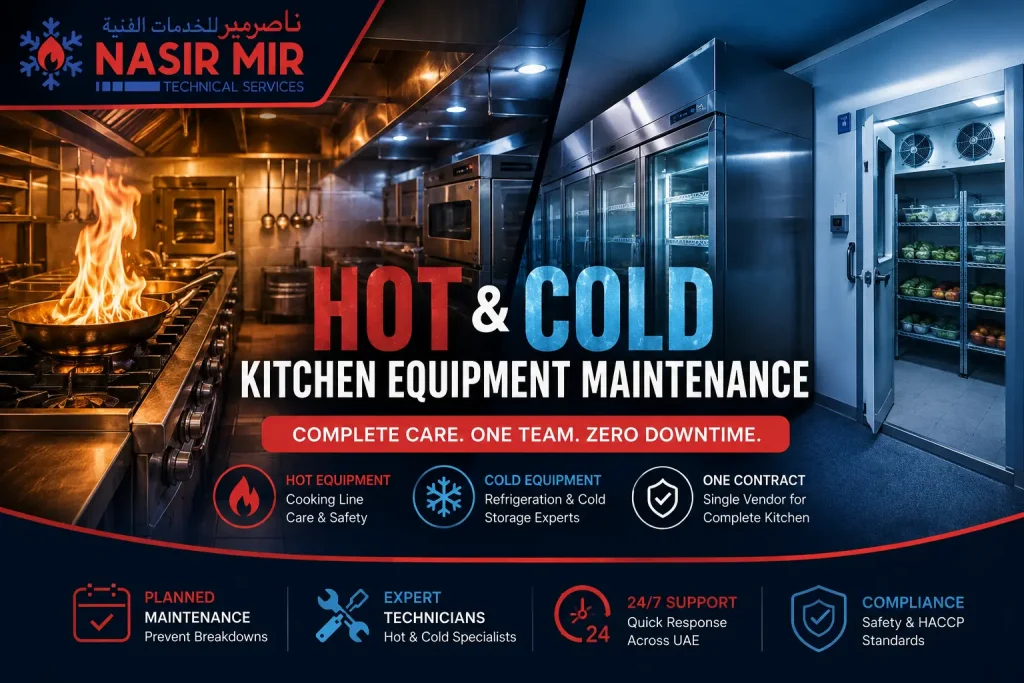
Hot and cold kitchen equipment maintenance covers two different systems running side by side in every commercial kitchen: the cooking line — ovens, fryers, grills, ranges — and the refrigeration line — cold rooms, chillers, ice machines. Each fails for different reasons and needs a different maintenance approach. NMT Services maintains both under one Annual Maintenance Contract across Dubai and the UAE, so kitchens don’t need two vendors for one kitchen.
Introduction
A commercial kitchen runs two systems at once, and they work against each other by design. The cooking line generates heat all day — ovens, fryers, grills, and ranges pushing 150–250°C for hours during service. A few meters away, the refrigeration line is fighting to hold 0–5°C in cold rooms and reach-ins, often in a kitchen where ambient temperature is already elevated by the cooking line itself. Both have to work, every service, without exception.
Because the two sides fail differently — a burner ignition fault has nothing in common with a failed condenser fan — most maintenance providers in the UAE specialise in one side or the other. Restaurants and hotels end up running two vendor relationships, two contracts, and two contacts to call when something breaks, for equipment sitting in the same room. NMT Services takes a different approach: one in-house team, one contract, covering both the hot side and the cold side of the kitchen.

What Counts as Hot and Cold Kitchen Equipment?
Hot kitchen equipment is everything on the cooking and holding side: commercial ovens (convection, combi, deck, pizza), ranges and burners, deep fryers, grills, griddles, salamanders, and hot-holding equipment such as bain-maries and holding cabinets. Cold kitchen equipment covers refrigeration and cold storage: walk-in cold rooms and freezer rooms, undercounter and reach-in refrigerators, display chillers, ice machines, and cold-holding units such as salad bars and buffet chillers. Together they cover every temperature-controlled surface a commercial kitchen depends on, and hot and cold kitchen equipment maintenance means keeping both sides running to spec — not just repairing whichever one fails first. For a full equipment-by-equipment breakdown of repairs and service tasks, see our Kitchen Equipment Repair guide.
Why Hot and Cold Equipment Need Different Maintenance
Hot-side equipment fails on calibration, ignition, and gas safety: a drifting thermostat, a fouled burner port, a failed piezo igniter, a worn door seal on a combi oven. The technician skill set is combustion and heat-electrical — gas pressure testing, thermocouple checks, element inspection.
Cold-side equipment fails on refrigerant, seals, and airflow: a slow refrigerant leak, a dirty condenser coil, a failed door gasket, a drainage line that’s backed up and iced over the evaporator. The technician skill set here is refrigeration-specific — pressure testing, coil cleaning, thermostat and controller calibration.
Because the failure modes don’t overlap, the inspection cadence doesn’t either. Hot-side equipment tied to grease production (exhaust, filters) needs attention every 4–8 weeks; cold rooms are typically checked every 3 months unless they’re storing high-risk stock like seafood or dairy, in which case that tightens to every 6–8 weeks. Our Kitchen Installation & Maintenance and Cold Room Repair & Maintenance teams run these as separate service lines internally, even though they’re delivered under one contract.
Hot Equipment Maintenance: What the Cooking Line Needs
Ovens & ranges. Burner calibration, thermostat accuracy, door seal checks, and steam generator descaling on combi ovens.
Deep fryers. Thermostat calibration, heating element inspection, and high-limit safety device testing — a fryer that overheats is a fire risk as much as a food-quality issue.
Grills, griddles & salamanders. Burner port cleaning for even heat, gas pressure checks, and grease trap clearance.
Hot-holding equipment. Bain-maries and holding cabinets need temperature verification to keep hot food above the safe holding threshold through service.
This is a condensed view — the full cooking-line breakdown, including common fault patterns, is in our Kitchen Equipment Repair guide. For bakery ovens and mixers specifically, see Bakery Equipment Installation.
Cold Equipment Maintenance: What Refrigeration and Cold Storage Needs
Walk-in cold rooms & freezer rooms. Refrigerant level checks, condenser and evaporator coil cleaning, door seal inspection, and drainage clearing — covered in detail in The 50°C Test: Commercial Cold Room Maintenance.
Undercounter & display chillers. Coil cleaning, condenser fan inspection, and door gasket replacement.
Ice machines. Scale removal, water filter replacement, and harvest cycle timing checks.
Cold-holding & display. Salad bars and buffet chillers need the same temperature-accuracy verification as walk-ins, just at smaller scale and higher visibility to guests.
New build or renovation? Our Cold Room Installation and Cold Storage Installation Guide cover installation alongside ongoing maintenance.
What Goes Wrong When Hot and Cold Are Split Between Vendors
The risk isn’t that a split-vendor kitchen gets worse service on either side individually — specialists are specialists for a reason. The risk shows up when systems fail together. On a peak summer day, a strained HVAC system and an overworked cold room can both start slipping at once, and a kitchen with two vendors is now coordinating two callouts, two response windows, and two sets of paperwork — while service is running. The same applies to exhaust: a fire risk from a neglected exhaust and hood system sits right next to the hot line, but if that’s contracted to a third vendor, nobody has a full picture of the kitchen’s condition.
For HACCP purposes specifically, this fragmentation is a real liability: temperature logs from the cold side and cleaning records from the hot side need to sit in one file for an inspection, not two.
Should Your Kitchen Use One Contractor for Both Hot and Cold Equipment?
For most UAE restaurants, hotels, and catering kitchens, yes — and it’s the model NMT Services is built around:
- ✅ One point of contact for any equipment failure, hot side or cold side
- ✅ One Annual Maintenance Contract instead of separate agreements with separate renewal dates
- ✅ Consolidated HACCP documentation — temperature and cleaning records from one team, in one format
- ✅ Faster response when hot and cold systems strain at the same time, since it’s the same team dispatching either way

Asif, Kitchen Installments
“The most common issue we see is a drifting thermostat on ovens and fryers that nobody notices until food comes out wrong. Regular calibration checks catch it before it becomes a bigger — and more expensive — problem.”
See the full scope under Our Services, or go straight to the Kitchen Annual Maintenance Contract page to set one up.
Hot vs. Cold Kitchen Equipment Maintenance Schedule at a Glance
| System | Component | Recommended Frequency |
|---|---|---|
| Hot side | Oven & fryer calibration | Every 3 months |
| Exhaust hoods & grease filters | Every 4–8 weeks | |
| Cold side | Cold room / walk-in check | Every 3 months (6–8 weeks for high-risk stock) |
| Ice machine full service | Every 6 months |
This is a condensed comparison — the complete equipment-by-equipment schedule, including dishwashers and grease traps, is in our Kitchen Equipment Repair guide.
Frequently Asked Questions
What’s the difference between hot and cold kitchen equipment maintenance?
Hot equipment (ovens, fryers, grills, ranges) is serviced for calibration, ignition, and gas safety. Cold equipment (cold rooms, chillers, ice machines) is serviced for refrigerant levels, door seals, and condenser cleaning — different specialisations, different inspection intervals.
Can one company maintain both the cooking line and the refrigeration line?
Yes, though many providers specialise in only one side. NMT Services runs an in-house multi-discipline team covering cooking equipment, refrigeration, HVAC, and exhaust under a single contract, so kitchens don’t need to coordinate separate vendors.
How often should hot-side equipment be serviced compared to cold-side equipment?
Oven and fryer calibration and cold room checks both run on roughly a 3-month cycle, but exhaust and grease filters tied to the cooking line need attention every 4–8 weeks — more often in high-volume kitchens.
What’s the risk of using separate vendors for hot and cold equipment?
Split vendors mean split accountability. If a cold room and an HVAC system fail on the same day, the kitchen is coordinating two callouts and two sets of paperwork instead of one — slower response, fragmented records.
Does hot and cold equipment maintenance affect HACCP compliance?
Yes. Local Municipality regulations require documented temperature records for refrigeration and regular exhaust-cleaning records for cooking equipment. Maintenance logs from both sides feed directly into HACCP audit documentation.
Does NMT Services cover both hot and cold kitchen equipment under one contract?
Yes. NMT Services’ Annual Maintenance Contracts cover cooking equipment, refrigeration, cold storage, exhaust, and HVAC under one team and one point of contact across the UAE.
Areas We Serve
NMT Services covers hot and cold kitchen equipment maintenance across the UAE, including:
Conclusion
A commercial kitchen doesn’t get to choose between the hot side and the cold side working — both have to run, every service, at the same time. The kitchens that avoid downtime aren’t the ones with the best fryer technician or the best refrigeration technician individually; they’re the ones with one team accountable for the whole room.
NMT Services maintains both the cooking line and the refrigeration line for restaurants, hotels, and catering kitchens across the UAE, under one Annual Maintenance Contract and one point of contact.
📞 Phone: +971 50 709 4400
🌐 nmtservices.ae