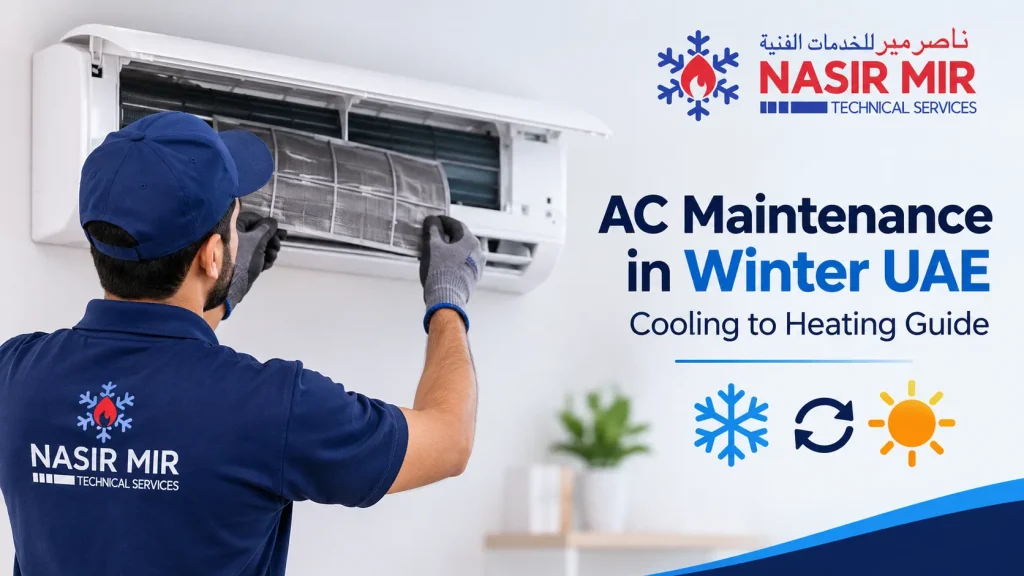
How to Maintain Your AC When Switching Between Cooling and Heating
By NMT Services · Updated 16 November 2026 · 7 min read
“It got cold, so we pressed Heat.” Except the unit was cooling-only, and nothing happened. Or it was a heat-pump model that had not been cleaned since May, and the warm air arrived weak and a little dusty. In the UAE, the first cool weeks catch a lot of AC units off guard.
The UAE is in its in-between weeks: mild afternoons, cooler nights, and a bit more humidity and fog. According to the National Centre of Meteorology, November highs and lows run roughly 4–6°C below October, and winter officially starts on 22 December.
This guide covers AC maintenance in winter in plain language: what to check before you switch, what really changes inside the unit when you go from cooling to heating, and when to call a professional. It is written for homeowners, tenants and facility managers, including anyone looking for AC service in Ajman or elsewhere across the Emirates, not just HVAC engineers.
To maintain your AC when switching between cooling and heating, do five things before you change modes: clean or replace the filters, wipe dust off the indoor unit and vents, clear dust and debris from around the outdoor unit, check that the condensate drain is flowing, and test the new mode for 10–15 minutes while listening for odd noises. Only heat-pump (reverse-cycle) units have a heating mode — if your remote has no sun symbol, your unit is cooling-only. Keep the temperature setting modest, avoid flipping between modes all day, and let washed filters dry fully before refitting them. Book a professional service if you notice weak airflow, a musty smell, water leaks, or cool air coming out in heat mode, because those usually point to a dirty coil, a blocked drain or a refrigerant problem that a quick wipe-down will not fix.
Three Mode Changes That Need Different Care
The quickest way to get this right is to ask one question: what do I need the AC to do right now — cool, heat, or just dry the air?
What It Does
On a heat pump AC, a reversing valve flips the refrigerant flow. Instead of pushing room heat outside, the unit pulls heat from the outdoor air and delivers it indoors.
How To Prepare
Clean the filters, clear the outdoor unit, check the drain, then run 10–15 minutes starting in fan mode before you switch.
Best For
Cool nights and early mornings. A modest setting in the low 20s is usually plenty for AC heating mode in UAE winters.
Watch Out For
Cooling-only units have no heat mode. Cool air in heat mode, or loud banging, means call a technician. A click and a short pause are normal.
What It Does
The reversing valve returns to its original position. The indoor coil absorbs room heat again and the outdoor unit releases it.
How To Prepare
Book an AC service before the first hot weeks: coil wash, drain flush, refrigerant check, and clear any leftover winter timers.
Best For
Late winter and early spring, when a fault is cheap to fix and technicians have the most availability.
Watch Out For
Weak cooling, ice on the indoor coil, a musty smell or dripping after months of mixed use point to a dirty coil or blocked drain.
What It Does
AC dry mode pulls moisture from the air without chilling the room hard. AC fan mode just moves air, with no cooling or heating.
How To Prepare
Wash filters and let them dry fully. Running fan mode afterwards helps clear leftover moisture from the unit.
Best For
Humid but mild evenings (dry), and gently restarting a unit that has sat idle for weeks (fan).
Watch Out For
Auto mode can bounce between heating and cooling on days with big temperature swings. During changeover weeks, pick the mode yourself.
First, Does Your AC Actually Have a Heating Mode?
Not every unit does. Many air conditioners in UAE homes and offices are cooling-only. A heating mode exists on heat-pump models, also called reverse-cycle. Three quick ways to check:
- Look at your remote for a sun symbol or a “Heat” button.
- Read the model label or manual for “cool & heat”, “heat pump” or “reverse cycle”.
- Ask the technician at your next visit — it takes them a minute.
If there is no heat function, no setting will unlock it, and rewiring is never a DIY job. If you want warmth from your system, our HVAC team can tell you whether a heat-pump replacement makes sense for your space.
The Pre-Switch Checklist: 7 Things to Do Before You Change Modes
None of these take long. Together they stop most of the problems we are called out for in the first cold weeks.
- Clean or replace the air filters. Dust from months of daily cooling sits in there, and a clogged filter strangles airflow in both modes. Wash, dry completely, then refit. If the unit runs daily, AC filter cleaning every 4–6 weeks is a good rhythm, and sooner after a dusty spell.
- Wipe the indoor unit and vents. Check the louvres and front grille. Black specks near the outlet usually mean damp dust, a sign to look deeper.
- Clear the outdoor unit. Remove leaves, sand, stored boxes and anything leaning against it. In heat mode the outdoor coil does the heavy lifting, so it needs to breathe.
- Check the drain. Humid mornings and fog mean more condensation. Look for drips, damp patches under the indoor unit, or a gurgling sound. A blocked drain is the classic cause of ceiling stains.
- Check the remote and old settings. Replace the batteries and clear leftover summer timers or sleep schedules set to 18°C. They behave very differently on a cool night.
- Do a 10–15 minute test run. Start in fan mode for a couple of minutes, then switch to the new mode. Listen, feel the airflow, and confirm the outdoor fan is turning.
- Write down anything odd. A rattle, a smell, a slow start. Small notes help the technician diagnose faster, and winter is the cheapest time to fix it.
What Changes Inside Your AC When It Goes From Cooling to Heating?
In cooling mode, the refrigerant picks up heat from your room and releases it outside. In heating mode, a part called the reversing valve flips the direction of the refrigerant flow, so the unit pulls heat from the outdoor air and delivers it indoors. It is the same machine running the cycle backwards.
That is why a heat-pump AC needs two things to stay healthy in both modes: clean airflow on the indoor side and a clean, unobstructed outdoor coil. UAE winters are mild enough that heat pumps do not struggle the way they can in freezing climates, but dust and neglected coils still cost you efficiency.
Sounds that are normal during a mode change
A click or soft “whoosh”, a short fan pause, and up to a minute before the air settles into steady warmth are all normal. Loud banging, grinding, repeated clicking or a unit that keeps cycling on and off are not — switch it off and call us.
DIY or Professional? A Simple Split
| Task | You can do it | Leave it to a technician |
|---|---|---|
| Filter cleaning | Yes, every 4–6 weeks | Included in a full service |
| Wiping vents and the indoor casing | Yes | — |
| Clearing debris around the outdoor unit | Yes (unit switched off) | — |
| Indoor and outdoor coil washing | No | Yes — needs proper tools and care |
| Drain line flushing | Only a visual check | Yes, if there are drips or gurgling |
| Refrigerant pressure and leak check | Never | Yes |
| Reversing valve and electrical testing | Never | Yes |
For the full list of what a proper service includes and how often to book it, see our complete AC maintenance guide.
Troubleshooting After the Switch
| What you notice | Likely cause | What to do |
|---|---|---|
| Cool air in heat mode | Cooling-only unit, wrong mode, setpoint below room temperature, or a reversing valve fault | Check the mode and setting, then call a technician if it persists |
| Weak heat or weak airflow | Dirty filter or coil, or low refrigerant | Clean the filter first; book a service if it does not improve |
| Musty smell on start-up | Damp coil or drain after weeks of idle time | Clean the filter, run fan mode, and arrange a coil clean if it stays |
| Water dripping indoors | Blocked drain line | Switch off and call us before it stains the ceiling |
| Unit will not change mode | Remote or thermostat issue, solenoid or control board fault | Replace remote batteries, then book a diagnosis |
Dust, Damp and the Air You Breathe
Winter weeks bring higher humidity and morning fog, which means damp coils and drain pans, and that is where mould likes to start. It is not only about comfort: UAE doctors quoted by Khaleej Times have warned that poorly maintained AC systems can circulate dust and mould and trigger respiratory symptoms, and they stress cleaning filters regularly.
Clean filters and coils also save money. The US Department of Energy highlights filters, coils and fins as the core of efficient AC maintenance, and puts the energy saving from swapping a clogged filter for a clean one at roughly 5–15%.
Why Winter Is a Smart Time to Service Your AC in the UAE
Demand for AC technicians is lower than in summer, so you get easier scheduling and a more thorough visit. Problems found now, such as a slow refrigerant leak or a tired fan motor, get fixed well before the first 40°C day. If you manage several units or a commercial space, a HVAC annual maintenance contract keeps those visits scheduled so nothing is left until April. Businesses running chillers or fan coil units can also read our guides on chiller maintenance in the UAE and fault-finding for FCUs.
Where We Help: AC Service Across the Emirates
NMT Services works across the northern and central Emirates, and the right winter routine varies a little by location. Nights tend to run cooler near the mountains, so heat mode may get more use in some parts of Ras Al Khaimah and Fujairah, while coastal areas stay humid and need more attention to drains and coils. Here is where our teams are on call:
- AC service in Abu Dhabi
- AC service in Sharjah
- AC service in Ajman
- AC service in Umm Al Quwain
- AC service in Ras Al Khaimah
- AC service in Fujairah
Looking for a wider range of services? See everything we offer in Abu Dhabi, Sharjah, Ajman, Umm Al Quwain, Ras Al Khaimah and Fujairah. Our head office is in Ras Al Khor, Dubai, and we also take AC jobs in Dubai. If you are in Sharjah, our Sharjah AC maintenance guide goes deeper on local conditions.
Frequently Asked Questions
Can I use heating mode on any split AC?
No. Only heat-pump (reverse-cycle) models have a heating mode. If your remote has no sun symbol or Heat button, the unit is cooling-only. Check the model label or manual, or ask a technician to confirm.
Should I switch my AC off completely during the UAE winter?
On genuinely cool days, switching it off saves electricity. Just do not leave dusty filters and a damp coil sitting for months. Clean the filters before the break, and when you restart, run fan mode briefly and check for smells or drips.
How often should I clean AC filters in winter?
Every 4–6 weeks if the unit runs daily, and always before you change between cooling and heating. Clean them sooner after dusty weather or nearby construction work.
Why does my AC smell musty when I turn it on after a break?
Usually a damp coil, drain pan or filter that has collected moisture and dust while the unit sat idle. Clean the filter and run fan mode first. If the smell stays, the coil probably needs a professional clean.
Is it normal for my AC to click or pause when it changes mode?
Yes. A click, a soft whoosh and a short pause are normal on heat-pump models, and the air can take up to a minute to settle. Loud banging, grinding or constant cycling is not, and needs a technician.
Is winter a good time to service my AC?
It is one of the best. Technicians have more availability, faults can be fixed before summer, and your unit goes into the hot months in good shape.
Which emirates does NMT Services cover?
We serve Abu Dhabi, Sharjah, Ajman, Umm Al Quwain, Ras Al Khaimah and Fujairah, and we also handle jobs in Dubai.
Book Your Pre-Winter AC Check
Tell us your emirate, the unit type and what you are noticing. We will tell you honestly what needs doing and what does not.
Message us on WhatsAppRelated reading: 24/7 emergency HVAC service across the UAE · HVAC services guide · Commercial HVAC solutions in the UAE